
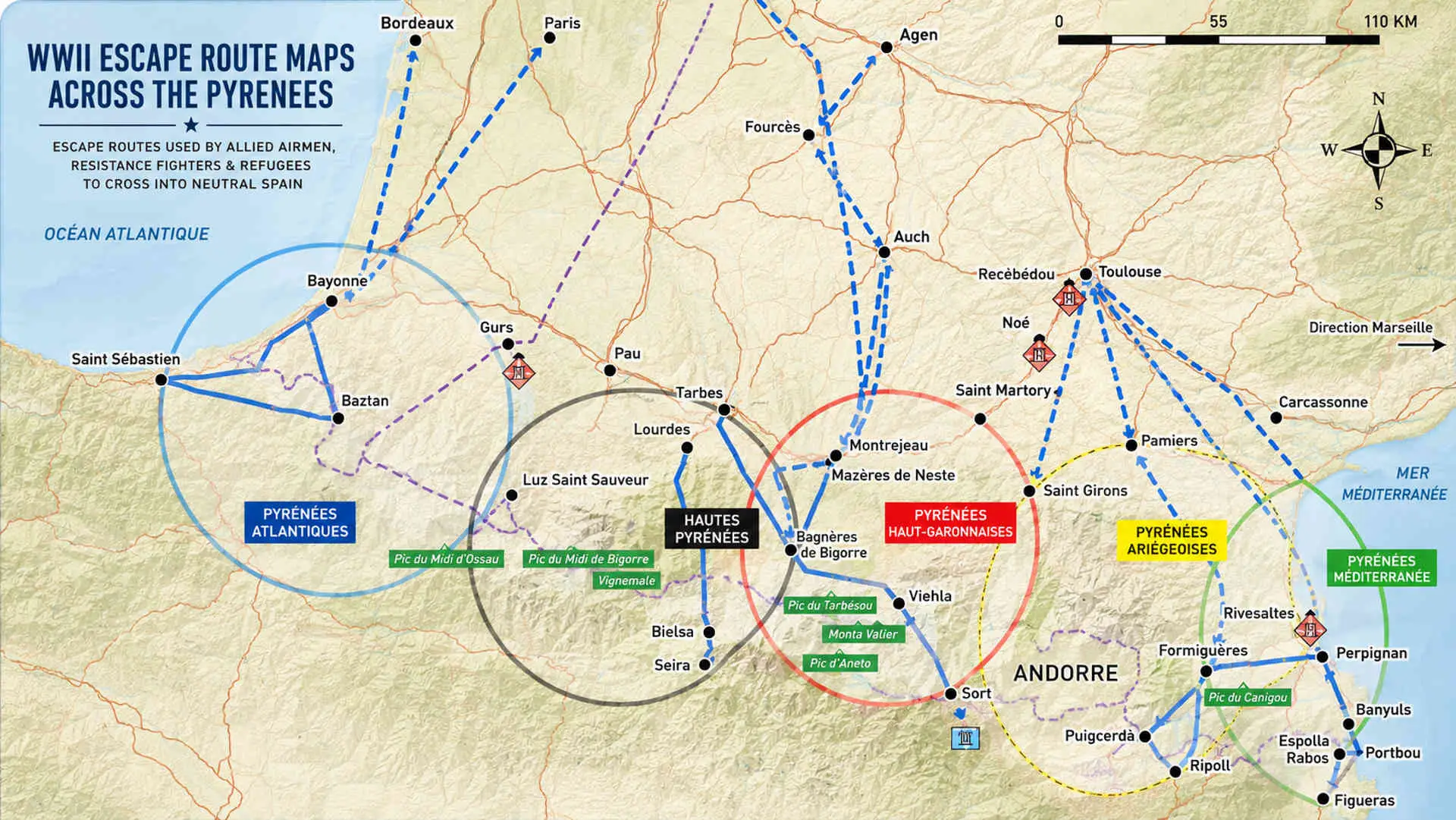
WWII Escape Route Maps Across the Pyrenees
Documented crossings, historical corridors, and the geography of escape from occupied Europe into Spain.
WWII escape route maps across the Pyrenees show a network of crossings, not one single trail. Allied airmen, Jewish refugees, resistance couriers, and civilian fugitives used different routes depending on guides, weather, patrols, and border conditions.
The best-known routes include the Comète crossings in the Basque Country, the Chemin de la Liberté in Ariège and Catalonia, routes through Andorra and Cerdagne, and Mediterranean crossings near Banyuls and Portbou.
Why the Pyrenees Became an Escape Corridor
During WWII, the Pyrenees formed the natural barrier between occupied or Vichy France and Spain. For many fugitives, reaching Spain was a step toward safety, repatriation, or onward passage through Allied networks.
These crossings were rarely simple mountain walks. They involved safe houses, local guides, night movement, false papers, border patrols, snow, exhaustion, and the constant risk of betrayal or arrest.
Major WWII Escape Route Areas Across the Pyrenees
The escape geography stretched across the full mountain chain. In the west, routes crossed through the Basque Country. In the central Pyrenees, routes passed through the Hautes-Pyrénées, Haute-Garonne, Ariège, Val d’Aran, and Pallars Sobirà.
Further east, escape corridors moved through Andorra, Cerdagne, Ripollès, Banyuls, Portbou, and the Empordà. Each area had its own risks, guides, terrain, and historical context.
Documented WWII Escape Itineraries
The following examples show how varied the Pyrenees escape network was. These were not all part of one organized route. They represent different historical itineraries, local corridors, and commemorated crossings.
- Comète — Bidassoa: Basque Country crossing used by Allied airmen between 1941 and 1943.
- Comète — Baztan: Another western Pyrenees crossing linked to the Comète escape network.
- Henri Cazaux Route: Hautes-Pyrénées to Aragón, connected with the Bielsa area.
- Jean Cazenave Route: A central Pyrenees itinerary crossing toward Aragón.
- Chuck Yeager Route: A route through the Haute-Garonne Pyrenees toward the Val d’Aran.
- Chemin de la Liberté: One of the best-known freedom trails, crossing from Ariège toward Catalonia and Sort.
- Douanier Parent / Claude Route: A Cerdagne corridor linked with the Núria Valley and Ripoll.
- Abbé Ginoux Routes: Cerdagne crossings connected with the enclave of Llívia.
- Col de Banyuls Route: Mediterranean crossing associated with Joseph Kessel and Maurice Druon.
- Walter Benjamin Route: The Portbou crossing connected with the philosopher Walter Benjamin’s final journey.
For a deeper look at one of the most famous crossings, see the Chemin de la Liberté WWII freedom trail.
Why There Is No Single “Freedom Trail” Map
There was no single official WWII freedom trail across the Pyrenees. Routes changed constantly according to patrols, snow conditions, available guides, arrests, informants, and the political situation on both sides of the border.
This is also why some modern route names can be misleading. For example, “The Nightingale” is connected to Kristin Hannah’s WWII novel, not the historical name of a documented Pyrenees escape network.
For this distinction, see the article on The Nightingale and the real WWII escape routes behind the story.
Can You Follow These Routes Today?
Some WWII escape routes can be walked today, especially where local associations, memorial projects, or hiking groups have preserved the route. The Chemin de la Liberté is one of the clearest examples, with a known historical itinerary and modern walking tradition.
Other routes are less straightforward. Some cross remote terrain, private land, high mountain areas, or places where the original wartime path shifted. In these cases, the most responsible approach is to understand the landscape through selected sites, documented crossings, and guided historical interpretation.
How Maps Help Understand the Escape Experience
Maps are useful because they show the scale of the escape geography. They reveal how far fugitives had to travel before even reaching the mountains, and how many different corridors existed between France, Andorra, and Spain.
But maps alone cannot explain the human experience. The real meaning of these routes comes from understanding who crossed, who guided them, where they were hidden, what risks they faced, and what happened after they reached Spanish territory.
Understanding WWII Escape Route Maps
WWII escape route maps across the Pyrenees show a network of survival rather than a single path. From the Basque Country to Portbou, these routes formed a hidden geography of resistance, refuge, and border crossing.
For travelers interested in this history, the most valuable approach is to combine maps with context: the people who crossed, the guides who helped them, the villages that sheltered them, and the mountain terrain that shaped every decision.
For travelers planning to understand this history more deeply, you may also find useful:
Exploring WWII Escape Routes from Barcelona
This private experience follows the history of Pyrenean escape routes through landscape, border geography, and research-based storytelling.
Explore the WWII Escape Route Tour